Give the Agent a Clear Target
Turn a feature request into small acceptance criteria. Use Claude Code to add status changes and filtering to the supplied lead dashboard.
Claude Code Shipping Lab
Turn your curiosity about AI into hands-on experience. Build on a ready-made lead dashboard with Claude Code, learn how to check its work, and follow the steps to share your project—with live guidance throughout.
For everyone curious about building with AI—complete beginners, career changers, freelancers, and developers. No prior coding experience required.
Thursday, October 15, 2026 · 11 a.m.–3 p.m. Eastern · $149 USD / £119 GBP
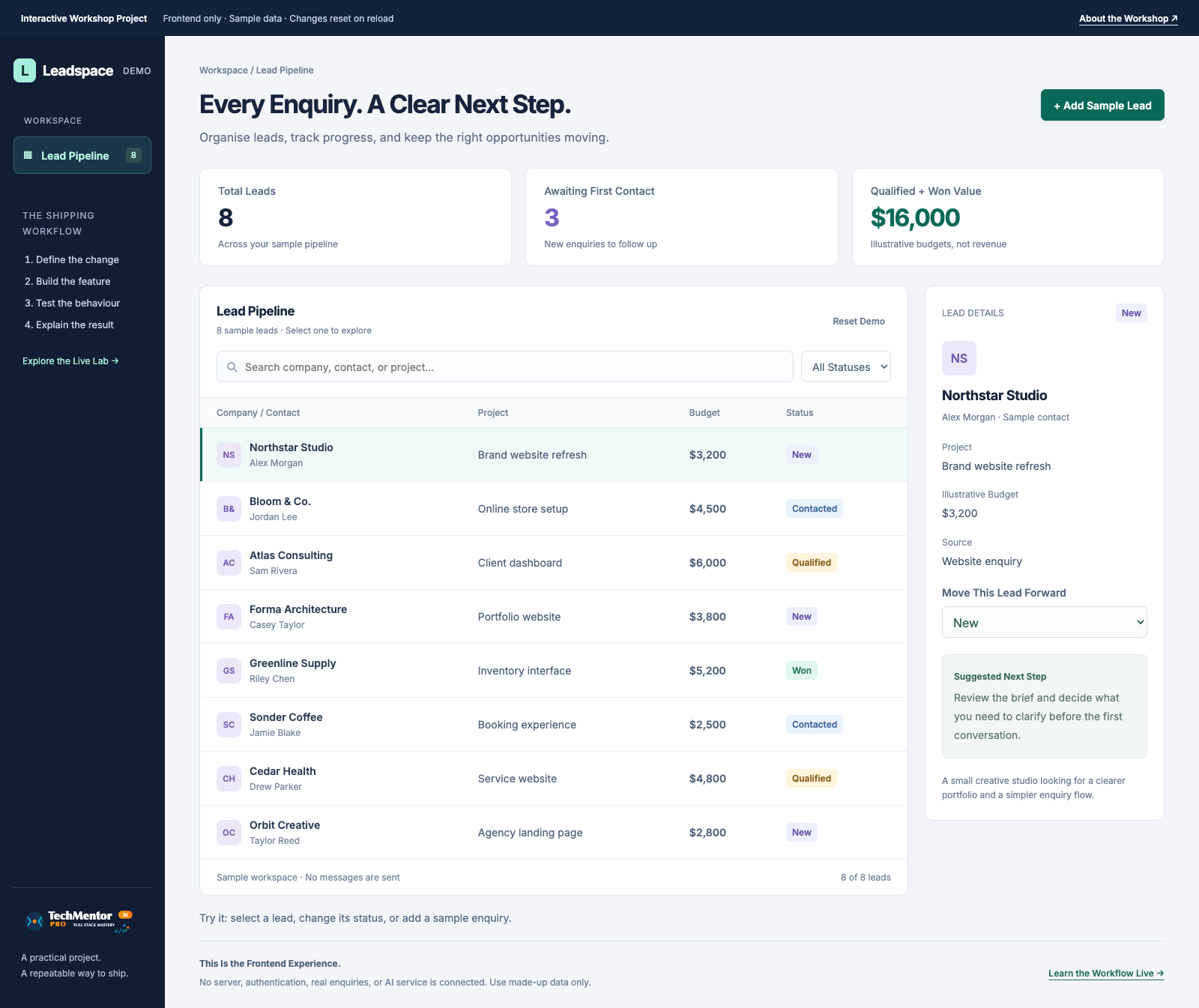 Open the Interactive Demo
No signup. No setup. Explore the frontend in your browser.
Sample data only—not a production CRM or a completed course project.
Try the Outcome Before You Choose the Workshop
Open the frontend demo and put it through its paces. Then practise the engineering behind this kind of experience: define the change, inspect the output, test its behaviour, and explain the result.
Take a 60-Second Test Drive
Frontend only. No account needed. Sample changes reset on reload. Workshop testing and deployment are not simulated here.
Turn a feature request into small acceptance criteria. Use Claude Code to add status changes and filtering to the supplied lead dashboard.
Inspect the diff. Check ordinary and invalid inputs. Reproduce a seeded defect, catch it with a failing test, and work through the repair.
Work through deployment and a smoke check. Explain the implementation and its limits in a README, with a verified local fallback if deployment fails.
The dashboard uses seeded, synthetic enquiries and local data. Authentication, a shared database, real lead capture, billing, and customer-data handling are outside this four-hour lab.
The Part That Matters After the Demo
A generated feature can look convincing and still fail on an edge case. The lab gives you a specific place to practise turning “it seems fine” into a check you can run, a bug you can reproduce, and a change you can explain.
See How the Live Session Gets You There ↓Bring Your Curiosity. We’ll Guide the Steps.
Whether you’re exploring AI for the first time, changing careers, freelancing, or already writing code, you can join. We use one supplied project, explain new concepts in plain language, and work through the essential steps together.
Ask Admissions a QuestionStarting from zero? You’re welcome. No JavaScript, Git, or terminal experience is required. We introduce the commands and checks as we use them. This is a guided introduction to a practical workflow, not a complete programming course in four hours.
One Shared Project. One Tool Path.
Build alongside the group, inspect the result together, and ask questions while the problem is in front of you. Two short breaks are built in.
00:00–00:35 · Get Comfortable
Tour the supplied starter, learn what the files and basic commands do, and run it together (20 minutes). Then describe one small change in plain language and agree how we’ll check it (15 minutes).
Checkpoint: understand the starter and the change we’re making together.00:35–01:15 · Build Along
Follow a guided prompt to add status changes and filtering with Claude Code. We explain what changed, where to find it, and how to try it in the browser.
Checkpoint: a feature you can use and a clearer understanding of how it works.01:15–01:25 · 10-Minute Break01:25–02:40 · Check and Fix
Try normal and missing inputs, then follow the instructor to add automated checks (40 minutes). Walk through an intentionally planted bug, read the error together, and use Claude Code to help fix it (35 minutes).
Checkpoint: practise checking AI output rather than trusting it blindly.02:40–02:50 · 10-Minute Break02:50–04:00 · Deploy and Explain
Deploy and smoke-test the demo (35 minutes), demonstrate it with peer and instructor feedback (25 minutes), then get the review submission checklist and next steps (10 minutes).
Checkpoint: a deployed demo or documented, verified local fallback, plus an explanation of its limits.More Than a Tutorial
Explore the interface on your own first. Join the live lab for a shared build, step-by-step explanations, troubleshooting when something breaks, and a review of the required exercise afterwards.

One guided setup path, so everyone can follow the same steps.
Follow the setup checklist to install the tools, sign into Claude Code, and open the supplied starter. You do not need to study programming in advance. Contact admissions if you get stuck. Claude Code access is separate from the workshop ticket; make sure your access and usage allowance support the session. Supplied checkpoints let you continue following the project if generation or tool access fails.
A Focused, Standalone Live Workshop
Build, test, and share a lead dashboard alongside a group working toward the same finish line. Beginners welcome.
Live online · Four hours including two short breaks · Maximum 20 learners
October 15 Workshop Ticket
$149 USDor £119 GBP
One payment for one four-hour live workshop.
Claude Code access costs extra. Any applicable taxes are shown at checkout.
Choose your currency · Secure checkout by Teachable
Same workshop and inclusions with either option.
Questions before you enroll? Book an admissions call or email info@techmentorpro.net. Review the purchase and refund terms displayed at checkout before paying.
Before You Commit
Still deciding whether this is the right next step? Talk it through with admissions.
Send a QuestionYes. No prior coding, JavaScript, Git, or terminal experience is required. We provide the starter, introduce the tools in plain language, and guide you through each essential step. Bring a laptop, working Claude Code access, and complete the guided setup checklist before class. You can revisit the recording for 30 days. The aim is to practise a useful AI-assisted workflow, not master programming in a single session.
A demonstration dashboard with synthetic leads, status updates, filtering, understandable validation errors, and a test that catches a seeded defect. You’ll practise deploying it—or documenting a verified local fallback—and explaining the implementation and remaining limitations in a README. Completion depends on preparation and participation; attendance alone does not establish that the exercise meets these criteria.
Neither. You’ll use Claude Code to help engineer an existing web app. You won’t build an AI model inside it. The exercise uses local, synthetic data; secure multi-user access, real customer data, billing, and production operations require further engineering.
You get scheduled practice, step-by-step explanations, live troubleshooting, a shared project with a clear finish line, and one review of your required exercise. If you only want introductory information about the tool, self-directed resources may be enough.
Bring working Claude Code access with sufficient usage allowance; it is not included in the ticket. This workshop uses one supported tool path rather than parallel Claude and Codex setups. The underlying habits—specify, inspect, test, and explain—can transfer to other coding assistants.
The starter includes known-good checkpoints, a guided test command, and a fallback deployment guide. Ask questions as we go, return to a checkpoint, and use the 30-day replay afterwards. You can follow the instructor demonstration and revisit the hands-on steps at your own pace. A verified, documented local build is the fallback if deployment cannot be completed.
Submit the supplied dashboard exercise within seven days after the workshop. One bounded review checks the exercise against its completion criteria, with feedback within the next seven days. Unrelated client projects and unlimited support are not included.
No. TechMentor has three learning formats: Live Cohort, full-library Self-Paced access, and goal-oriented Live Workshops. This is one standalone workshop, with no automatic cohort credit or library access. It is also separate from the beginner-focused AI Web Freelancer Launch Lab.
Choose the $149 USD or £119 GBP option above and complete secure checkout with Teachable. Both options enroll you in the same live workshop on Thursday, October 15, 2026. Workshop access and preparation information are hosted in your Teachable course. Review the purchase and refund terms at checkout, and contact admissions if you have questions before paying.